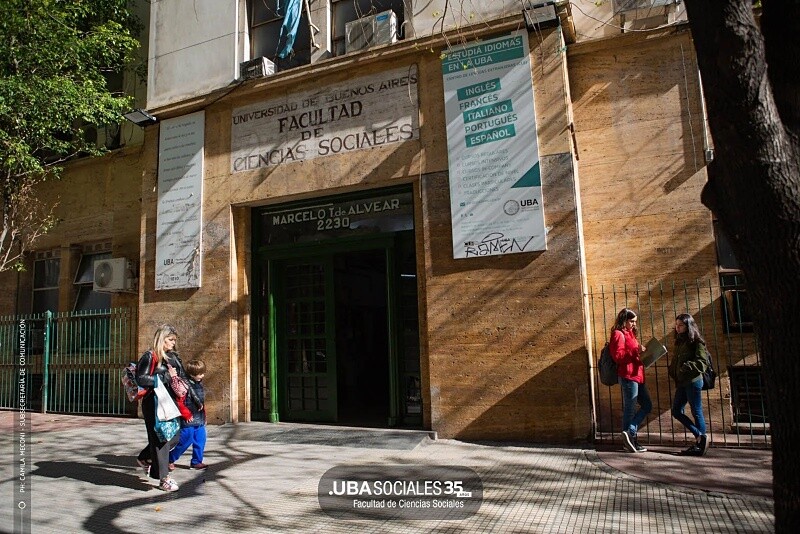
Even when the whole world screams 'there is no alternative', there is always a margin. The market as nature, inequality as landscape, politics as an obstacle (sound familiar?). The end of history, ideologies, the proletariat, grand narratives, and everything else too... But at Eméte, time was not pure administration. It was a way of forming, not just in the academic sense of the term. The nineties came with a state narrative that was a local translation of an international mandate: there was no alternative. The market as nature, inequality as landscape, politics as an obstacle (sound familiar?). The end of history, ideologies, the proletariat, grand narratives, and everything else too. But at Eméte, time was not pure administration. Or it was in the 'high spheres' of its barrani cliques and its bureaucratic structures as careerist as all the others. One of the most interesting vital sensibilities of the period, against which we argued a lot about things that are now just anecdotes (the unforgettable 'Long live the crumbs!'). It could be a factory of bonds, ideas, tools for not resigning. And that, in a country that time and again goes to the brink of the abyss, is not intended to be a romantic tribute to a place that was neither idyllic nor heroic, but the rescue of a space, a time, an experience, a history. Or it moved, which is a more meticulous way of saying the same thing. The country was being privatized, but the faculty, at times, was becoming more social. Ricardo Sidicaro and that way of reading Argentine politics as a real machine: gears, interests, traditions, without moralizing. It was a way of being in the world. Many carried their defeats on their backs, their youthful mistakes or their horrors of adulthood, and some were tired souls, but they had not lost their lucidity or their passion. For those of us who spent a few years there (too young to have certainties, old enough to have anguishes), Eméte remains a reminder: a public university can be much more than a degree factory. Social Sciences, before being a building, was a nervous system spread across headquarters: an idea that sought to lodge where it could, as if the university itself was practicing what it taught: that institutions also survive by patches and fights for unity. Despite everything, Eméte had something that today is difficult to describe without falling into that sentimental trap that turns the past into a souvenir. It was learning that politics can also inhabit an uncomfortable bench, a shared table, the gesture of lending a note, the organization for something to happen, or in an endless discussion from which, suddenly, the new emerges. They were professors in an era when it was believed that the public university was also a collective conversation for or against destiny. Eméte had leaks, small classrooms, broken windows, worn-out steps, saturated notice boards, corridors that became a human tide at the end of class. Just a memory caught on the fly, as it flashes in the moment of danger. But all that coexisted with the heated discussion that made Eméte something different. That was the mystique: a porous university, a building where many sought to put theory to use and not on a pedestal, where knowledge—for many others—was not a privilege but a tool. In the nineties, the faculty taught that history is not a closed script. Emilio De Ípola, with his precision without stridency and a pedagogical irony that drew laughter and loosened the body to facilitate the entry of ideas. Horacio González, obviously: an open book, an identity of its own, and at the same time a dialogue with all traditions in an unfathomable head: from Ignacio Anzoátegui (the author of 'Life of the Dead') to Santucho and Gombrowicz; from Martínez Estrada to Gramsci; from Borges to the unjustly forgotten Luis Franco. More out of precariousness than conspiracy. Eméte had leaks, small classrooms, broken windows, worn-out steps, saturated notice boards, corridors that became a human tide at the end of class. In the nineties, it was exactly the opposite: it was the place where the 'new' did not come in the form of a polished PowerPoint presenting 'the last cry' in a dead language, but in the gathered body that showed you that you were alive and that politics is the art of the impossible... until it becomes possible, or at least desirable. In Eméte, they discussed everything, general or particular, tactical or strategic: budgets, quotas, study plans, parallel chairs, building conditions, career directions, the 'observed votes' at six in the morning with dark circles under the eyes after the long night of the last day of elections. Also in wasting time (or gaining it) by mumbling intelligent or absurd hypotheses about the great ideas of Argentine or universal thinkers. And his last activity, a participation via Zoom in the presentation of that book. And there were those most aligned with our universe of ideas: El Chipi Castillo, who was from the family and our young promise, later a national deputy with his corresponding 'Aula 100 moments' as had been predicted by Martín Rodríguez; Claudio Katz, from whom I was left with an early interest in transformations in the world of work, or Pablo Rieznik, with whom you could have a thousand differences, but whose booming voice was part of our political education. There are eras, and one decides whether to inhabit them as a spectator or as an actor. The nineties came with a state narrative that was a local translation of an international mandate: there was no alternative. With that twilight of places not designed to be beautiful, but to be useful: a refuge from the elements, a transit station, an improvised stage, and sometimes, a battlefield. But that precariousness (against which we fought, obviously) was not only lived as a lack: it was also learning. Politics is not born in ideal conditions, it is born in real conditions. That is why Eméte was, for many, a school of a deeper idea: there are no 'good times' for doing politics. And the mystique of Eméte was also that of certain teachers who gave classes as if the class were a public event. Juan Carlos Portantiero, with that presence that forced one to think about the link between defeated democracy, Mexican exile, controversial transformative language, conflict, and political direction (I was part of a takeover against Portantiero and I insulted him in all languages, including the sectarian one). They were not saints or oracles. A bastion too plebeian or 'lefty' invading the left margin of a good neighborhood like Recoleta. One walked through those green or yellow corridors as if advancing inside a metaphor: in a country where 'giving birth to the future' had become a risky operation, we had settled there to learn to name it, understand it, or transform it. The address was precise (Marcelo T. de Alvear 2230), but the feeling was always a bit clandestine. It was to cross paths. To discuss was a form of breathing. One could leave a class with Gramsci, Weber, or Marx bouncing in one's head, and ten steps away, join an assembly where theory had the obligation to translate into voice, slogan, anger, procedure, open microphone, disorder, voting; minorities asking for the word, majorities not letting it go, and that stubborn faith that the collective decision served for something. The country was being privatized, but the faculty, at times, was becoming more social. There was a bar in the basement. Except for the fatalism of eternal spectators (great exegetes of all inevitable defeats), those who never believe that there is any margin: neither in Eméte nor in Constitución nor in Puan nor anywhere else. One day Eméte was gone. It was to build networks and friendships. There, presentations, meetings, political discussions, some exhibition, some brawl, some recital, some talk that started with 'ten minutes' and ended with the last train were mixed. The bar, or the bars around the headquarters, were the heart of a simple idea: university life was not just going to class. 'Does the structure dictatorially determine the superstructure or merely condition it in a more relational lax regime?' The word 'assembly' today carries a contemporary irony: it sounds like something old, like an excess, like going too far, like the noise of another era. But the country was also discussed. The Federal March of '94, the fight of '95 against 'the LES', or the one of '99 passed like rivers that overflowed the university. The escraches to genocides also: a way of understanding that democratic freedoms are not exhausted in formal institutions, that there are memory battles that are fought in the street, in civil society, in organizations. In a mobilization against Bill Clinton's visit (those marches where the first question upon arrival was: 'Has Quebracho already ruined it?'), in the retreat before violent repression—out of instinct or who knows why—a few of us ran about thirty blocks to end up taking refuge in Eméte. Perhaps something of the spirit of the Walsh Papers inhabited us: no one retracts towards the void, but towards the known terrain; towards common practices, towards one's own history, one's own culture, towards the components of one's identity. That was the mystique: a porous university, a building where many sought to put theory to use and not on a pedestal, where knowledge—for many others—was not a privilege but a tool. In memory, buildings are remembered because in some secret place they keep the echo of their voices. There were farewells, photos, end-of-era rituals. It was not a sphere reducible to 'a nice memory'. Although it always returns. Rubén Dri rescuing the freshness of Marx's 'Manuscripts of 1844' and the place of Kojève and 'The Master and Slave' in Hegel in his own transition from theology to criticism. I did not go to any of them. His last text published in life was precisely the prologue to the reissue of 'Hudson a caballo' by 'The Poet of Belén', the writer and essayist from Catamarca, 'trotskyist-spinozist'. It was to live. Dark.